
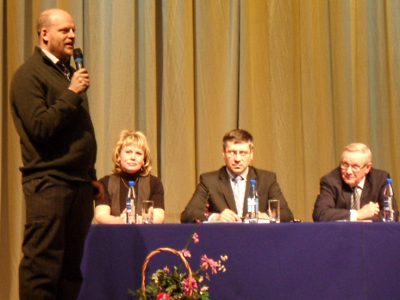
Bilingualism makes people more creative and successful in social life. This point of view was expressed by the professor of the University of Helsinki Janne Saarikivi on the closing of the conference “Innovation projects in the national education” held in Syktyvkar on February 9.
“Linguists tend to talk about the importance of saving the languages, but we rarely think, why it is indeed so. The fact is that a language is a combination of many aspects: it is means of communication and thinking, instrument of labor, vehicle of national identity. When a language dies out, the whole system of notions disappears, and a certain worldview full of creativity, which doesn’t exist in other languages, - explained the scientist. – For example, in the Komi language there are a lot of figurative expressions: ‘enezh’ means ‘the sky’, but literally translated, it means ‘the cover of God’. The Komi language has its own special worldview, mentality, and if the language disappears, they will disappear as well. And it will be impossible to revive them.” According to the scientist, the optimum alternative is when a person learns two or more languages since childhood. Life practice confirms that people, who have a good command of several languages, are more talented and make a more successful career than those who speak only one language.”
“Bilingualism in Russia is not admitted, and even during population census people should chose only one language and nationality, let say, Russian or Komi. The Russian multilingualism is asymmetrical: national minority representatives ought to know the language of majority, and not vice versa. Even in the regional centres of the national republics where 80 per cent of the population speak its own language, the majority representatives aren’t determined to know the language of the place, - described the situation J. Saarikivi. – In Russia there is a tendency of the so-called national minority folklorization: it is allowed to use national ornament as decoration, but it is prohibited to use national languages in mass-media, education, governmental affairs. Teaching of the local languages is opposed to teaching of the foreign languages. I believe this shouldn’t be”.
The scientist gave several examples of the symmetrical bilingual societies. Thus, in Belgium, Switzerland, Canada different languages have full functioning possibilities in various regions of a country, in the United Kingdom and Spain it is possible under federalism pattern, and in Finland a citizen has the right to apply to the government using any of the two official languages in the whole territory of the country.