
/In order to satisfy the regulations of the European Charter for Regional and Minority Languages Russia should take some steps, which can promote the Lappish language status and secure possibilities for its maintenance and development in the Russian Federation. This point of view was expressed by the Doctor of philology, professor, dean of the philological, journalistic and cross-cultural communication department, manager of the Lappish language laboratory of Murmansk State Humane University Olga Ivanishcheva, when commenting on her participation in the international academic-and-research conference “The Lappish national identity: issues of language and culture maintenance in the North” for the media-centre FINUGOR.RU. The forum took place in Murmansk on 10-11 of March.
According to her, Russia has not ratified the Charter, but ought to do it in the future. If Russia had joined the treaty, the government would have had to fulfill some engagements. “In my conference speech I explained, which steps concerning the Lapps should be taken in order to satisfy the regulations of the European Charter for Regional and Minority Languages. First of all, there should be passed a statute of the Lappish language – in the Murmansk region there is still no such a law. In the regional Duma this issue has already been touched upon, but it should be promoted and supported by the Lappish community.
The use of the Lappish language in every-day life is very restricted: it concerns almost only the realization of the project “The Lappish radio” which was started in 2003 and closed in 2010; the Lappish language courses; “the language nest” idea, which is now being developed. However, there are as well Lappish language classes taught at school and vocational school in the village of Lovozero. The Lapps of Kola communicate actively with the Scandinavian Lapps. For our part, we suggest including the master program “The Lappish language and culture” which was developed by our effort, into the university studying plan.”
The speaker explained that this project can be realized on the basis of Murmansk State Humane University (MSHU). “The program is expected to include studying of grammar, vocabulary, sociolinguistic and culturological aspects, folklore and fine arts. The students would learn the Lappish history and ethnogenesis. This course may be taken not only by the Lapps themselves, but by all the students interested. The graduates could work at schools, institutes of higher education and other cultural institutions – teach the language, do scientific and research work. This knowledge can be as well very useful for the officials who are engaged in the Lapps national affairs, - remarked O. Ivanishcheva. - Unfortunately, the federal educational standard plan does not include such a program, but we could organize one on culturology, jointly with Tromso University, for example, and involve the Lappish language”.
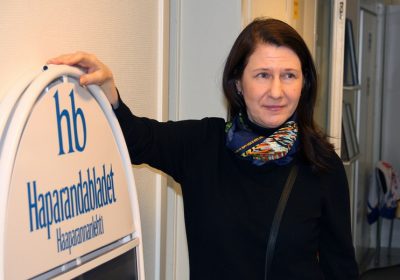
Photo from the web-site of MSHU, department of cross-cultural communication, linguistic theory and journalism