
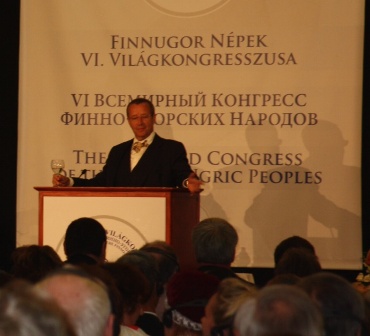
 The president of Estonia Toomas Hendrik Ilves revealed the economic causes of the problems of the Finno-Ugric world and found unexpected comparison to neighbors at the VI World Congress of the Finno-Ugric people in the Hungarian city of Siofok on September, 5th.
As he said, referring to the implementation of the decisions of the 5th Congress of Finno-Ugric people and a present condition of the Finno-Ugric world, it is necessary to understand, that economic realities have changed in 4 years.
"The forecasts that were given by the pessimistic analysts, now all of us have felt on themselves.
Economic shocks have affected the cultural policy: workplaces disappear, expenses on culture are reduced - the culture suffers most of all. The egoistical purposes of governors of the states are that, that they prefer short-term benefits and completely forget that existence and culture cannot be reduced to a single Homo economicus, - stressed T.H.Ilves. - Each nation can give an example of how in these difficult times dreams are not realized."
Then the President told about the history of the Museum of the Estonian nation, which had existed more than 100 years, but for various reasons had no constant own premise. 5 years ago the decision to build the museum was accepted, the architectural project was developed, but it has not been realized because of problems in terms of co-financing from the EU. "In the debate on this matter we did not receive any response from the people in Brussels, which were responsible for the project: they doubted that the project will pay off. Nevertheless the Estonian people have not lost hope that we will build a museum," - he said.
"The financial crisis and globalization have led to the temptation to evaluate everything only from the point of view of benefit. To keep the Finno-Ugric people and their languages is not profitable; it is easier to go to one language, such as English, Russian or Chinese. We do not accept such way, it is a way to death", - T.H.Ilves declared.
Further the president of Estonia compared the necessity of preservation of the Finno-Ugric people to the conservation of biological diversity in the ecosystem - the small nations whose culture is different from the mainstream civilization need a special protection. T.H.Ilves compared it with the white-trunked pine and a huge Chinese salamander, as rare species which require special protection. "It is important to save the ecosystems. Even the creation of cultural autonomy will not save the people if there is no protection of its habitat, - he explained. - The protection of nature is the protection of the Finno-Ugric peoples."
According to him, the publication of Livonian-Latvian-Estonian dictionary was an example of how big nations help to save the language of small people (in this case, Liv). On the other hand, we should not be afraid to publish books about the oppression of the Finno-Ugric peoples. "Finno-Ugric people must defend their freedom," - T.H.Ilves concluded.