
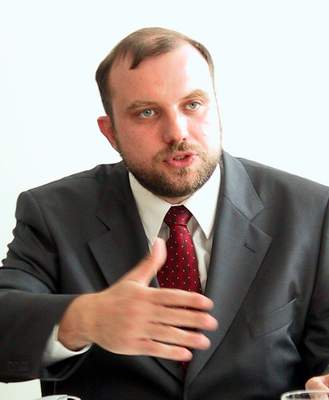
The FINUGOR mediacenter presents the abridged version of our exclusive interview with the Estonian ambassador to Russia, Jüri Luik in which the diplomat tells us about why Estonia will receive two hectares of Russian territory upon conclusion of a border treaty. The full version of the interview is available in Russian.
J. Luik gave an interview to the mediacenter on the results of his official visit to the Komi Republic. Delegates from the embassies of Hungary, Finland and Estonia came to the Republic on the 27th-30th of May on an invitation from its head, Vyacheslav Gayzer to study the Komi experience on the preservation of national culture.
Mr. ambassador, have you ever visited Komi before?
This is my first official visit to your Republic. The thing is, the ambassadors of the Finno-Ugric nations – Estonia, Finland, and Hungary – traditionally go together to a Finno-Ugric region in Russia once per year. This is a very good tradition, that lets us become acquainted with the situation on the ground. I’m happy that I came to Komi.
What is your assessment of what you’ve seen in Komi?
The whole visit has been very interesting. I’ve been trying to better understand the lives of the people in the Republic. For me personally, the most interesting thing was meeting students from Syktyvkar University. I was glad to see that the students were asking honest and open questions without any especially political rhetoric to us, the ambassadors, and we answered them honestly as well.
We’ve been to the Finno-Ugric cultural center of the Komi Republic, and the Federal Finno-Ugric cultural center – they do great work, and it’s interesting to see that. Such activism is needed. Ethnic identity, language preservation – these are issues that must be addressed, and beyond present support activities at that, with more serious work. Speaking, for example, about the Komi language, it’s important for it to stay a living language, rather than a museum exhibit. And to do this, it’s necessary to rapidly develop vocabulary and terminology in the language, so that it can be used by Komi businessmen, and Komi engineers alike, so that the Komi language can be used not just on the household level, but in all serious spheres of life and work.
There need to be Komi language dictionaries. It’s good that there is a Komi-Russian dictionary, but there needs to be a Komi-English one – do you have one?.. Well, it’s needed. English is the lingua franca of the modern world, it’s the language of the Internet, and computers – young people today spend all their time in the virtual world… If a language cannot be used in that system, then it isn’t a living language.
What is your assessment of Estonia’s activity in the Finno-Ugric movement? Is there not a downward trend? Last year on the eve of the World Congress of Finno-Ugric Peoples, prominent movement activist Andres Heinapuu said in regards to this that among Estonians, interest in participating in that forum has fallen – fewer people wanted to come than to preceding Congresses.
Even today we have a whole group of enthusiasts who are actively working with the problems of other Finno-Ugric groups, whose souls ache for Finno-Ugric peoples – among them are Jaak Prozes, Andres Heinapuu, Tõnu Seilenthal…
It’s just that life changes with time. There was a romantic period once. And today we live in the European Union, we’ve got somewhat more bureaucracy. Today, understanding is important: what can be done concretely, what can be prepared for the future. Today we need not only enthusiasm, but also persistent, day-to-day work, we need the institutionalization of these activities. But, of course, observing these bureaucratic rules and regulations, it’s impossible to lead the matter to stagnation…
We need to think more about how to use the possibilities of Europe to help our colleagues here, and especially in the realm of education.
Mr. ambassador, currently the Ministries of the Interior of Russia and Estonia are actively working to prepare a border treaty. In the Estonian press, I read with surprise that territory along the border is going to be exchanged – in one place, Russia is giving Estonia a hectare, in another place, Estonia is giving Russia a few hectares, but in total, Estonia stands to gain two hectares. Why is this exchange of land taking place? This is quite a mystery…
Actually, this is a fairly simple question, though a normal audience wouldn’t be aware of the specifics, of course. The areas to be exchanged are very small, and this exchange is planned in order to have a convenient border in places. Because, in fact, the present Estonia-Russia border is the same as the administrative border between the once existing Soviet Republics, the Estonian SSR, and the RSFSR. As you know, in the Soviet times, it simply didn’t exist, it was theoretical, people crossed it back and forth without any kind of visa. While today, it’s easier to exchange little bits of land to make the border itself go more smoothly in terms of layout.
Speaking of the preparation of the treaty itself, I can say that we would be glad to have a solution to this problem right now. Thankfully, it seems this process is currently moving in a positive direction.
The small ethnic group, the Setos live on both sides of the border, both in Southwestern Estonia, and the Pskov oblast of Russia. Will collaboration between the Estonian and Russian Setos continue after the final regularization of the border issue?
Without a doubt. We have actively working projects on the Setos, and it seems to us that if both countries have a clear understanding of this topic, then there shouldn’t be any problems. Beyond that, a near-border partnership could receive support from the European Union, which means more funds.
Of course, we are interested in making sure the Seto live well. Let’s try to make it be that way.
What can you say about the pressures of globalization? Is Estonian society threatened by gradual Anglicization?
We do not see Anglicization as a threat to Estonia. Earlier I spoke of a living language, and we’re actively working, our linguists are working to make sure the Estonian language has modern terminology. Something is easier to say in English, because it is a language with a very rich vocabulary, a modern language, but all the same your native language must be developed! This is the most important principle.
Preserving identity means not only preserving the past, but also working on a modern level in modern life. Otherwise the language and then the nation will become exhibits in a museum.
A clear problem in terms of preserving national identity for Estonia is that we’re now in the Schengen zone: our doctors and engineers can choose the best place for them to live and work, whether that’s Finland, Germany, France… The problem is keeping well-educated and qualified people from leaving the country, and trying to get those who have left to return. This challenge exists for any nation, but for a small one like us, it’s a very serious one. And we’re talking about that in Estonia now. Brain drain – highly qualified specialists can leave and go to any other EU country.
I wouldn’t say that it’s a huge problem or a tragedy for us… Life in a free area has its advantages. But somehow we must rise to that challenge.
In reading the Estonian press, it’s easy to see that Estonians are expressing their concerns about relations with Russia. Throughout the Post-Soviet years, the Estonian governments have warned of the threat from the East, building on the foundations of the national unity of the new country. At the same time, in recent years, more and more people are expressing ideas that Estonia shouldn’t be the armed border between big Europe and big Russia, but a bridge between two big world regions. This middle position gives Estonians the ability to profit from transit and good relations on both sides – somewhat like Finland did after the Second World War. Do you think a change in general strategy for relations with Russia among Estonia’s political elite is possible?
For Estonia, Russia is a very important factor. The question of relations with Russia has always been discussed in Estonian society, and not only among politicians.
I think people want normalized relations between Estonia and Russia. We should look to the things that unite us, because we are neighbors after all… We have a lot of moments in common in terms of economics.
But to be a bridge, means that both sides need to have an interest in that. I think the talks happening right now about the border have given some positive momentum for the solving of lots of issues, but there still remain differences in understanding between us and Russia. We need to accent the things that bring us together, not what drives us apart. No matter, it remains to be seen! I hope for the best!