
Specialists from the Bureau of Official Translation (BOT), acting as part of the Academy of State Service and Administration of the Komi Republic told the FINUGOR Infocenter about jobs their organization works on, and problems that arise in the process of BOT’s work.
We remind our readers that the Bureau began its work in February 2012, and today its employees work to carry out the law “On the Official Languages of the Komi Republic,” which guarantees the translation of all official documents from the government, the State Council of Komi, electoral bulletins, and also texts from municipal administrations and commercial organizations.
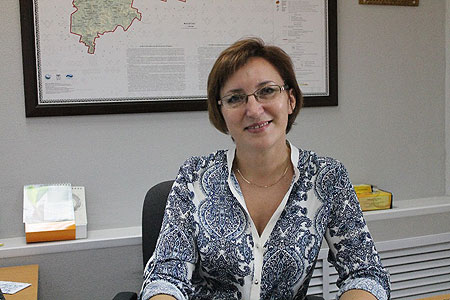
The head of the Bureau of Official Translation and PhD in Philology, Marina Fedina and senior editor Olga Isakova sat down for a chat with a FINUGOR correspondent about this job.
FINUGOR: The Bureau of Official Translation has already been working a bit more than a year and a half. What exactly is it that its employees are working on today?
MF: From the very beginning, the Bureau has been working to complete the assignment entrusted to it, namely the translation from Russian into Komi of the texts of laws and regulations enacted by the government of the Republic, the State Council of Komi – it’s an official assignment, and we are obliged to see it done. All these documents must be published in the Komi language in the magazine “News About Laws and Regulations From State Bodies of the Komi Republic.”
Last year we were still translating all the decrees of the ministries, but that’s a disproportionally huge amount of work in relation to our staff size, and to add to that, these documents are largely of a technical character, which is why this year we were relived of that job. But, all the same, the burden is still quite large. We don’t even have time to breathe.
We’ve been entrusted with the job of completing translations on the official Internet portal of the Komi Republic – bit-by-bit we’ve translated its basic static sections, while simultaneously translating current news.
OI: We’re translating electoral bulletins in preparation for the upcoming elections. Interestingly, the Northern municipalities of the Republic, Vorkuta, Inta, Usinsk, where there is a comparatively small proportion of Komi people, they’ve asked us to translate even candidate biographies into Komi, while the southern, traditionally Komi districts only want the bulletin headlines translated.
MF: I’d also like to note that there’s nowhere else in Russia with a similar structure. Of course, in other Finno-Ugric republics of the Russian Federation, someone’s translating for the regional governments, but that’s either employees of the administration of the head of the republics, or humanitarians research institutes subordinate to the local government… In that sense, the Komi Republic is a pioneer in having created a special subdepartment responsible for official translations.
FINUGOR: How many employees does the Bureau have, and what’s their workload like?
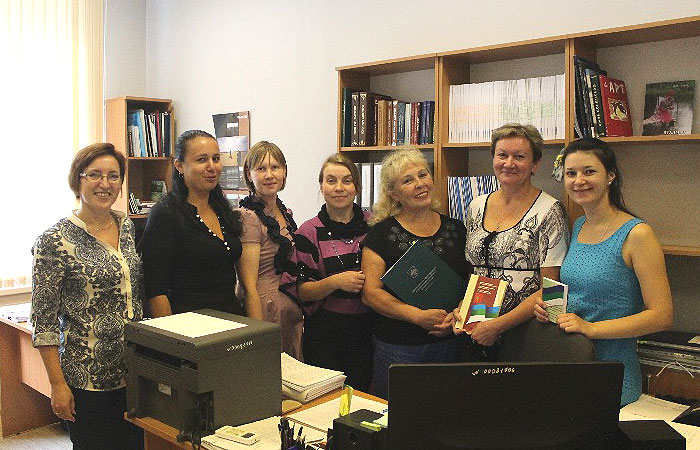
MF: The Bureau has 10 employees, seven of which are directly working on translation. Two editors control for quality, checking texts in Komi, and sometimes translating themselves if there is a particularly high amount of work to be done. The Bureau’s standard is to translate 12.5 million printed characters per year. This means each translator should be translating 6 thousand characters of text without spaces per day. That’s around 4 pages of solid text. Of course, we often get packets of texts where the information is given in, for example, table form with a lot of empty cells, but the quantity of characters remains 6 thousand. That said, in practice they often have to translate much more. And what’s more, if you consider the specifics of lexicon and genre – in order to properly translate, you need to understand the essence of the law and the sense of the terms in Russian – it’s a very difficult type of work.
OI: In addition to written translation, employees of the Bureau often have to interpret at events. For example, at conferences, congresses of the Komi people, meetings of the Interregional movement body “Komi Voytyr,” events with a Finno-Ugric focus. Normally we take two translators to such events, because interpreting requires frequent breaks: a person can’t provide quality translations in such a rapid-fire manner.
Truthfully, interpreting is the most complicated type of translation work – not every qualified translator is capable of doing it. For me, for example, it can even get psychologically difficult. On the other hand, two young women working for us manage to do it pretty well, despite the fact that no one trained them to do this.
MF: Our experience with actual interpreting has shown that our workers have to go through some kind of heightened qualification specifically in that area. And here we ran into the problem that this service simply isn’t offered: you can easily get trained to interpret a well-known European language, but for minority languages, such language courses are just not available. I’d suppose that in Karelia, there might be something connected with preparation of interpreters, because Finland is right next door, but even there is no preparation for interpreters. Even in Tatarstan we couldn’t find a system in place to train Tatar language interpreters. For us, there isn’t even anyone to check our specialists’ level in Komi language, but we’d like to see something in terms of the theoretical and methodical part that could help us improve the quality of our work.
FINUGOR: Is there any way out of this ever more complex situation?
MF: All the same, there is a general Finno-Ugric movement, the Association of Finno-Ugric Universities is still active – in Universities philologists are being trained in Finno-Ugric Languages – I think the Finno-Ugric republics of Russia should work together to train interpreters in their native languages. With all of us working together, we can try to develop interregional courses for the training and retraining of such specialists.
FINUGOR: Do you ever get commercial orders for translations from Russian into Komi? In general, how in-demand is the Bureau’s work?
MF: I’d say that’s a political question – and a question for the leadership of the Komi Republic, not us. In so far as the Komi language is official in the Republic, laws should be translated into Komi and published in it. The government supports the work of the Bureau.
OI: The administrations of the cities and districts of our Republic sometimes are sent names, forms, and texts for translation into Komi by commercial businesses, and it’s not expensive. Recently a bank from Moscow got in touch with the Bureau with a request to translate a memo and several other materials of that financial institution into Komi for a client. They’re probably getting ready to open a branch in Komi. We can only be happy to see a company having that approach to the Komi language. Fairly regularly we hear from companies in charge of the construction and repair of roads in Komi: they win bids from the Roads Agency of the Republic, and as part of that they have to install signs with the names of populated areas, rivers, and some other geographic features in two languages – Russian and Komi. For example, we’ve talked to road-builders from Udmurtia and even from Ukraine. The Bureau has one more function – consulting in translation into Komi. The districts send us their own versions of translations, and we check them over, correct errors, if there are any, and send back the edited texts signed by the rector of the Academy on an official form. In the Priluzsky district, for example, they translate the electoral bulletins themselves, and they get sent to us just for editing and confirmation. It’s also happened once in the Ust-Vymsk and Izhemsk districts, where they have specialists with a very high level of Komi.
These constant requests to the Bureau show the high level of demand there is for our work.
FINUGOR: You translate from Russian into Komi, but do you ever go in the opposite direction?
OI: Yes, sometimes we do such written translations. Normally we get such requests from the Ministry of Culture or the Ministry of National Politics: If a person from a district wrote a letter to the ministry in Komi, they are required by law to answer in Komi! In principle, there are a lot of people working in these ministries who speak Komi very well, and could be reasonably expected to be able to write an answer, but it has to be official, and only our translators can give a document that status.
FINUGOR: Are there any linguistic difficulties in translating from Russian into Komi?
OI: Of course, in terms of richness of vocabulary, Komi is still lagging behind Russian as a result of decades of Russification of the Komi language. But all the same we try to use Komi words. If long-existing Komi words aren’t enough, we look to recently published dictionaries, and for geographic terms we consult philologists from the Komi Research Center… Sometimes though, we just can’t find a good term in Komi, and in those cases we make our own recommendations for the creation of a new term and bring them to the Vocabulary and Orthography Commission of the Komi Republic, which decides on the term, after which it becomes a confirmed part of the Komi language.
The developments of the Interregional Laboratory of Information Support of the Functioning of Finno-Ugric language, which is a part of theCenterofInnovative Language Technologiesof the Academy have helped us a lot. The laboratory created the system of automatic orthography checking for the Komi language, and they are now working on a unified lexical base for the Komi language – all of that makes our work with Komi language texts a lot easier.
FINUGOR: What kind of texts are the hardest to translate?
OI: The most complicated translations are for financial documents, texts on economics, and it is also very hard to translate legal decisions, as we have to translate all decisions of the Constitutional Court of the Republic into Komi. In all honesty, modern legal and economic documents aren’t understood by a normal person even in Russian, and we have to adequately translate these difficult texts into Komi… Sometimes we have to organize whole brainstorming sessions just for one document.
FINUGOR: Is there a lot of interest in working with the Bureau among the population of the Komi Republic?
OI: A lot of specialists in the Komi language ask to come work with us. Maybe in the future, if there will be an expansion of the states, someone could bring that dream to life… Last year we had a group of fifth-year students from the Komi language department of Syktyvkar University come to us – they tested their abilities, but they didn’t get it right away. We need to actively use new words and terms, and they just can’t do that. We even made a request at SU for future Komi philologists to undergo a course in official business translation.
In my own time as an employee of the ministry of national politics of the Komi Republic, I would go into the districts as part of special “raids” to check the accuracy of signage in the official languages of our Republic. I remember once in the village Zelenets, we were doing such a check when we were warmly met and supported by Oleg Lazhanev, who was the head of the village’s administration at that time – now he’s the head of the Syktyvdinsky district, and as before a “Komi Voytyr” activist. I think it’s fully possible to do further work in that regard. Truly, the Bureau doesn’t have such authority, but if the national ministry were to continue making such “raids,” we could be called upon as official experts to carry out that assignment.
FINUGOR: What would the employees of the Bureau like to see in the future?
MF: Again, we need to specially develop the field of translation into Finno-Ugric languages, especially interpreters. We home that with time the size of the Bureau will continue to increase, because the amount of work, both in terms of the government order, and other sources will only continue to grow.
OI: We’ve already accumulated quite a bit of experience, and it would be interesting to share that at Finno-Ugric seminars and Conferences, to talk with other specialists dealing with similar problems. At the end of the day, that’s our common mission – to work for the good of our native languages.