
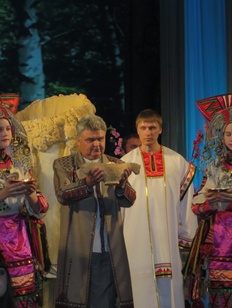
 On 26th of September the work of the V congress of Finno-Ugric people of Russia started in Saransk. The chairman of the Association of the Finno-Ugric of Russia, coordinator of International Advisory Committee of Finno-Ugric people, the mayor of Saransk Petr Tultaev opened the forum in a folk costume. He also took part in a theatrical performance and headed the delivery of two-meter-height generic candle on stage,nazaccent.ru informs.
Greeting to the participants of the Congress from the President of Russian Federation Vladimir Putin was read out. In his message the head of the government noted that the support of native schools, languages, cultural and educational centers will surely have the further development. “Your forum permanently raises important and actual questions concerning the large family of Finno-Ugric people and also is bringing people together around common goals and targets. Finno-Ugric people have made a great contribution into forming and strengthening of the Russian statehood, developing of science, education and art. Their unique traditions are our common heritage, an essential part of cultural and ethnical diversity, which is and had always been the strong point of Russia. I emphasize that we give priority to the problems of preserving the identity and originality of every nationality and also to strengthening of interethnic consent and harmony. And that is why the development of the program on supporting national languages, schools, cultural and educational centers will go further, large-scale educational, interregional, international projects will be implemented”, - the President’s message says.
In his report on the last four years of the work of the Association of the Finno-Ugric People P. Tultaev concluded that Finno-Ugric languages’ scope of functioning is not getting any wider. The problem is aggravated by the fact of losing of translation school within the Finno-Ugric language family and population decline in Finno-Ugric areas excluding Khanty-Mansi Autonomous Okrug (Yugra).
“Without including Finno-Ugric languages into the school system, the further progress of this course will be problematic. One should be involved with native cultural and language environment”, - the chairman of the Association stated.
The mayor of Saransk thinks that for promoting national languages it is necessary to elaborate an online library of literature on Finno-Ugric languages and also to enlarge the amount of TV and radio programs hosted in national languages at the territory of Finno-Ugric regions of Russian Federation. The necessity of creating a unified Finno-Ugric encyclopedia was noted in particular.
Also, P. Tultaev advocates for recommencing the practice of sending talented Finno-Ugric youth to study in A.M. Gorky Literature Institute in Moscow.
Considering that, the head of the Association also outlines that during the past four years the number of regional departments of the organization has grown in Russia. Also, a constructive dialogue with the authorities was established. Moreover, in different areas Finno-Ugric people are living a number of events were held – festivals, conferences. Many publishing projects came true, for example, the tutorial “Finno-Ugric world” was published.
Delegates from Karelia and Khanty-Mansi Autonomous Okrug have showed their concern about the situation of closing departments of national philology at universities. Speakers say that in future it may affect negatively on preparing language specialists.
It’s worth mentioning that this year for the first time all the speeches and reports performed by leaders of regional delegations were written in mother tongues with the synchronic translation for the other participants of the congress.