
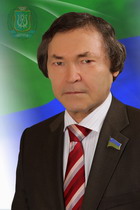
 “Preservation of culture of small nations is a sign of a developed country”, thinks Jeremiah Aipin*, Khanty writer and social activist. In his opinion, Russia will go the way of Finland, the United States and Canada, trying to solve this problem. Or it will lose a unique treasure. InfoCenter FINUGOR presents an interview of J. Aipin for a newspaper " Arguments and Facts -Ugra".
- Jeremiah Danilovich, we all understand that a culture of small nations under the pressure of technological civilizationcan turn into a souvenir brand. Is there anything left yet?
- Culture is preserved in places, where the language and the traditional way of life are preserved too. The indigenous people of Ugra consist of two separate groups. About 3 thousand people are the bearers of the culture in its original form. They live in nomad camps and follow the lifestyle of their ancestorsand sew traditional clothing. But the most important thing - these people retained their spiritual culture. They tell theirchildren stories in their native language and perform differentceremonies.
The rest live in cities and towns, where there is no language environment, and the folk culture is distorted. Sacred ornaments go for souvenirs, traditional designs are used everywhere and out of place. According to the last population census only 30% of the Khanty and 10% of the Mansi consider their national language as a native one. Others from birth speak in Russian, because their parents are sure that their native language is not useful. There is only one hour per week dedicated to learning the national language. And those classes are optional.
- So, the culture may be preserved only by living in camps? Not by studying at schools?
- I am a proponent of a natural movement of life. Nowadays cell phones and diesel power plants are used even in the traditional settlements of the Khanty and the Mansi. They go on snowmobiles, not on reindeer. There’s nothing we can do to that. The state should help to enter a university to those who have abilities, but at the same time it should not interfere with the people who decided the finish only primary school and then lead a traditional way of life. Still, everyone has to be able to read and write. All received primary education at least during the Soviet period, there was no illiteracy. Today – there is. In remote camps parents do not want to send their children to boarding schools, but today there are no other options for studying. This year about 30% of the Khanti and Mansi children of the Surgut district didn’t go to the Lyaminski boarding school.
- Why there aren’t any camp schools?
- Actually, we had two camp schools. The first, a family one, was closed because the children had grown up. And there was an unpleasant story with the second one. The director assured me: the school was closed because the parents believe that it was better to send their children to a boarding school. And after a conversation with the parents I found out, that they actuallywanted to keep the school, but the director just could not find a teacher. Administration of educational institutions makes no effort to support this trend. In addition, there’s an optimization trend. It is expensive to keep a camp school, the cost of education per student is too high. Not only these but all other small schools are closed too. Children suffer because of economy.
- A seminar on the improvement of the Khanty and Mansi languages was held recently. What’s the purpose of such events?
- It is wonderful but we want to “revive” the language there should be a necessity in it. We have to create a stimulus. For example, require knowledge of the language of those who claim to privileges. Or introduce bonuses for knowing languages of small nations, as in Finland. By the way, in the Russian language, especially in different dialects there are more than two thousand Khanty words. For example, "pelmen" is just one ofthe Khanty words. "Pel" means ear, "men" - bread, and it turns out to be a "bread ear ". In Ugra Khanty and Mansi languages can be learned on free courses, but it is difficult to find even five or six people to create a group.
- The Khanti and Mansi who live in cities forgot their traditions. Is it possible to reverse the process?
- There are a lot of people whose belonging to indigenous nations is shown only in their birth certificates. Khanty and Mansi of older generation say: "We were not taught our mother tongue in boarding schools, it’s not our fault that we lost everything." And they're right. In the eastern parts of Ugra many indigenous people could lead a traditional way of life, but theirlands were alienated for oil production lands in the Soviet period. People are forced to migrate to cities and towns. And this isn’t their fault either. They need help to learn the language,to go back to their roots. In the USA half of Indians live in cities, but they still preserve the national awareness. The state creates special conditions and economic mechanisms for their survival.
- By the way, what do you think about ethnotourism?
- It is no good for indigenous peoples, but it is necessary. Before the development of oil and gas Khanty and Mansi had supportedthemselves with the production of fish and furs. But now rivers are polluted and there isn’t enough fish. Fur is worthless due to saturation of the market with cheap fur from Turkey. Several families in the Nizhnevartovsk region receive tourists, but this is an unorganized tourism, when outsiders come home to Khanty, blurs the culture and belittles it. We should create specializedcenters with professional staff for the development of ethno-tourism. The only possible invasion into the life of indigenous peoples is excursion to camps. In fact, only a return to the traditional lifestyle will help to preserve the unique culture.
*Jeremiah Danilovich Aiping was born in 1948 in the village of Varyogan of the Nizhnevartovsk district of Khanty -Mansi Autonomous region. In 1976 he graduated from the A. M. Gorky’s Moscow Literary Institute. He is a writer, a deputy of the State Duma of the first convocation, a deputy of the Ugra Duma and the chairman of the Assembly of Indigenous Peoples of the North. He is also a bearer of the order "For services to the Fatherland".