
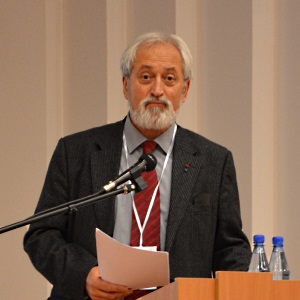
A famous Hungarian specialist on the Finno-Ugrians and the head the Collegium Fenno-Ugricum Institute, professor Janos Pusztay took part in the all-Russian scientific-theoretical conference “Political, economic and sociocultural aspects of regional governance in the European North”. The forum was held in Syktyvkar in the Komi Republic Academy of civil service and management on the 24th - 25th of October, 2013.
The report of the outstanding scientist was devoted to the theme of schools, that teach students using their mother tongue. J. Pusztay reminded the delegates that Komi literary language was created in the XIV century by the baptizer of the ancient Komi, Stephen of Perm and, thus, the Komi language became the second written language among the Finno-Ugric ones and after the Hungarian language. The next stage of rapid development of the Komi language took place during the 1920s, when Lenin's nationalities policy was implementing. “It was a beneficial period for the peoples of Russia: national schools were created, many teachers were trained, textbooks, dictionaries and grammars in native languages were written, a lot of documents were translated and literature of indigenous peoples appeared. It is worth noting that, during the harsh years of the Great Patriotic War literature and textbooks in the languages of the peoples of Russia were coming out in greater numbers than they’re now”, - said Janos Pusztay.
However, during the 1950s, according to the speaker, the process of Russification began: at first Russian vocabulary penetrates into the languages of small peoples, then, in the 1960s many national schools were closed – teaching there was translated into Russian. “Now there are generations that grow up without learning the native language”, - concluded the guest of Syktyvkar.
In the 1990s there was a new surge of national identity, many laws, which gave the languages of the peoples of the Russian Federation equal rights with the Russian language, were passed.
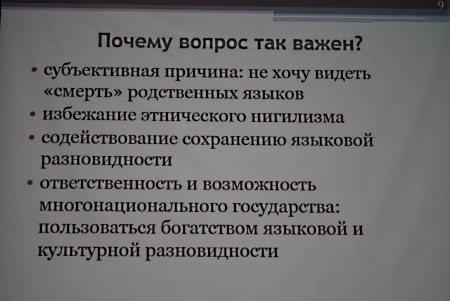
Nevertheless, according to J. Pusztay, the question today is how alive and how often the minority languages are used. “It is necessary to speak not only about how to save the language, but also about how to use it. Native language is not an exhibit in a museum, which must not be touched – on the contrary, it should be used, and that’s the only way the language may become viable. The most precious gift that parents can give to their children is a language and culture. Multiculturalism is good for people. The State should understand it, it must not fear but support the linguistic and cultural diversity. The native language should be used at the lessons of biology, mathematics, physics, Informatics – at all of the lessons. Next step is the use of the native language in cultural, social and political life. What law prohibits using of the native language in parliaments and governments of the republics of Komi, Udmurtia, Mari El, Mordovia? It is the responsibility of politicians to be a model for the indigenous population, to use their own language”, - said the scientist.
“There’re prejudices that the Finno-Ugric languages are undeveloped... These statements are true, yes, but it is not so difficult to create modern terminology. The Komi language, for example, has the status of a state regional language, so you can work with it. In our days there is a constant creating of different terms - and the Komi language may become a full-fledged state language”, - noted J. Pusztay.
The Rapporteur also recalled that several years ago, the current head of the Center for innovative language technology of KRASSaM* Marina Fedina has implemented a large project on creation of terminological dictionaries for schools in the Komi, Mari, Moksha, Udmurt and Erzya languages – about 50 dictionaries altogether. “Analysis of the terms of the Komi language isn’t complete yet, but I can already say that the Komi language may be both a state language and a language of teaching”, - said J. Pusztay.
Further, according to him, everything depends on the policy of Federal authorities on language issue. “If the decision is positive, we can start preparing new textbooks, training teachers and introducing a teaching in the native language. Otherwise, all of this will become a “Potemkin’s village” – all efforts will be useless and the languages will die out. I would not like to see the death of the Finno-Ugric languages – most of them can be saved, thus we can maintain existing linguistic diversity”, – concluded J. Pusztay.
* - Komi Republican Academy of State Service and Management