
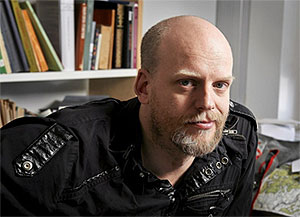
Media center FINUGOR presents an exclusive interview with Janne Saarikivi, Professor of Uralic Languages Faculty of University of Helsinki. The scholar has been studying Finno-Ugric languages for 20 years, and he devotes a lot of efforts to projects on saving languages of small-numbered peoples of the Uralic language family, promotes the possibility of the smallest languages revival.
Janne, the data of population census and social researches show that languages of small-numbered peoples – and even quite big-numbered – are steadily losing in number of native speakers. Finland in early 1990s has tried a method of creating “language nests” in kindergartens, in order to save the minor Inari-Sami language, and then recommended it to the Russian Finno-Ugrians. But, for example, Olga Konkova, the Chairperson of the Vod and Ingrians Society, supposed last year, that even this measure will not save the Ingrian language, because it is spoken only by elderly people, who evidently will not be able to work as educators at a pre-school institution. Is it still possible to save the minor languages from disappearance? Why do they disappear?
Yes, I know about the situation with the Ingrian language and I am aware of what the matter is with that. To save a language is possible almost always, but not necessarily by one and the same method in every certain case. So, different technics for saving a language can work, and even if we see some positive results – the critics can always point to the fact, that the saved language form is in some parameters different from that “classic” language, which existed before.
Reasons why the languages of peoples of the world disappear are quite numbered. If we combine different processes into one phenomenon, we will notice that none of the present-day languages is what it used to be a hundred years ago. A hundred years ago people, for example, the Komi in the middle of nowhere – and in the other regions of dwelling of the Finno-Ugric people, lived in a traditional village society, everyday communicating with each other by means of the native language, although these were different dialects, and the standard literary Komi language did not yet exist.
The common Komi people of that time could not read and write in their language, and for small-numbered representatives of originating Komi intellectual class written Komi language did not play significant part in their lives. The Komi language was just a means of communication; it was spoken with relatives and neighbors. And so it was with all minor languages.
Now the language is considered a labor tool, instrument, way of creating identity, partially it has become artificial, because we get the knowledge of words and terms of language not through the live communication, but at school. We use more and more literary language rather than dialects. And this situation is determined by the requirements of the modern economy, industry, social institutions.
Languages die out not only because somewhere there is a bad language policy led by local authorities, the language does not have an official status, the demographic situation is in bad state, there is not enough money…
It is a global process connected with modernization, transition from traditional society to modern, urban, informational. A hundred years ago for the whole parish consisting of several Komi villages there was only one Russian priest, sent by the church authorities.
Now the number of people living traditional style is becoming lower, agriculture is becoming mechanized, people are moving to the cities and are engaged into professions which require common state language – and this is the language of dominating people, of the majority. And if during the period of industrialization technic was the main factor of industry, according to Karl Marx, once famous in Russia German economist and thinker, now, during the period of post-industrialization, language has become an important factor of industry – as a result of the fact that the leading role today belongs to creativity, innovations, and the creative thinking is very important.
As a result, now it is easier to preserve the languages which are used in the educational process, mass media, administration, documentation – where they function in the process of labour, of creating an identity. But other languages may as well be preserved, if the specific character of every certain case is taken into consideration. In this sense, I couldn’t say that the situation in Russia is much worse or somehow different from that in other countries. It is of special character, but the modernization process and changes in the society and economy are much the same.
What is the key factor for saving minor languages?
If the minor languages die out, there are many guilty of it, but if we are to name the main reason of languages dying out, it will be educational system, because it is usually based on the major languages. At present, in Russia there is a dominant position, according to which only Russian must be used at school, and other languages may be taught as separate subjects. Whereas, even now in Russia there are such schools, where educational process is carried out in the language of the local people – in Tatarstan, Bashkortostan, Yakutia, Tyva, and Chuvashia till the 5th form, yet, it is very difficult to find information on how educational process in the language of the local people is carried out in every certain region. Probably, somewhere else in Russia there are schools with national languages, but I don’t have information about it. But in Tatarstan the majority of the Tatars still attend the mixed Russian-Tatar school, if we can say so.
We can compare it with the situation in Finland – where all educational process can be passed in full in the Swedish language – the second official language of our country: from Swedish-speaking kindergarten to institution of higher education. But even for those who got education in the Swedish language, Finnish became prevailing in everyday life, because it is actually the main language in Finland, as well as Russian in Russia. In our country sooner or later everybody learns Finnish: our Sami, and the Swedish-speaking, and immigrants. In Russian the situation is similar: the pressure of the Russian language is rather strong, and it leads to the fact that now almost everybody knows it, even if they were taught in their native language at school. So, the concerns of some officials and social activists that those who are taught in their native language will know Russian badly are absolutely exaggerated.
Sociological studies, which we carried out, show that in Russia for many native speakers of minor languages, the social networks were the Russian language is dominating, still prevail.
And I don’t state that the whole educational system 100% shall be built up in the Komi or Chuvash languages-no, education should be bilingual.
“Language nests” are excellent tools for that. In Syktyvkar, for example, there are many people Komi by origin, but because of current everyday business it is difficult for them to transfer the Komi language to their children, who perceive everything through the Russian language. And in this case the “nest” can give them knowledge of the native language as well. It would be of use to introduce the teaching process in the native language at the elementary school, and then at the secondary school there may be made a smooth transit to the Russian language, and the USE (Unified State Examination) may be passed in Russian – it will be quite realizable.
But there were times when there were national schools in Russian…
The Soviet Union was the first state to demonstrate such a vivid interest to the minor languages – nowhere in the world in 1920-30s there was carried out such an active language policy, or there were developed systematically the languages, which were nonliterate. In the USSR there were created national schools at that time, school books were composed, teachers were educated. In Europe it was the time of nationalism of big nations, intolerance towards the national minorities. Only after the World War Two in Europe local national minorities became protected, and appeared an idea that preservation of ethnic and language traditions is a treasure. In in the USSR the language policy took the other course similar to that which was in Europe before the War.
It is worth remarking, that in 1920-30s in the USSR the national movement came in many ways from above, and in Europe the national movement for preservation of the native language and ethnicity came always from below, was truly national. In Finland, for example, both workers, and left-wing powers, and church, and conservatives – all stood for use of the Finnish language instead of Swedish or Russian.
Yes, at first it was the intelligence movements, but later it was caught up by the general public. In Russia there was no such a movement, there was an order from above: to establish, let say, for example, the Komi republic, the Komi written language, literary language, the Komi literature itself, the Komi national school, newspaper, theatre…
And so it was almost with all national minorities in Russia.
At that time it bore wonderful results, but they all vanished, when the policy of authorities changed. If the national movement had initially been popular, if the civil society had been born, the results of that rise would have survived. As long as there was no civil society in the USSR, the situation was easy to turn upside down. And while the situation with minor language in Europe has become better than it was before the War, the situation with the minor Finno-Ugric peoples in Russia has changed to the opposite.
The reason for that is the mentioned modernization. In Russia it started later and came in many ways from above, and not from below. But the thing is, industrialization in Russia has finished, the majority of population lived in the cities, just the small part stayed for living in the places of their initial inhabitance, the situation with minor languages will again be changing to the better, but on a new basis. In China, India, Latin America modernization started later than in Russia, and their minor languages experience or will experience some problems – until the corresponding stage in the society development is finished.
I think in modern Russia preservation of languages of its nations is in many ways the business of the state, school, and the civil society.
But till the present day the Russians have had belief that it is up to the state to take decision, for example, binding to speak the native language. The state can create conditions promoting functioning of languages, let say, to introduce the language knowledge requirements for certain positions, but this will not be enough if there is no understanding by the population, by the civil society, that the native language is necessary, that it is a treasure, that is why it should be spoken, preserved and developed. I want to underline the responsibility of the people themselves who are waiting for the state to make decision for them. And again everyone waits for the order from above to resolve the issue, as it was in 1920-30s…
What changes to the better do you see as far as the Finno-Ugric peoples in Russia are concerned?
In Europe, after a period of pressure on the minor languages, mentality had changed, they are now regarded not as something backward, archaic, non-prestigious - but as valuable cultural phenomenon. In Finland, now it is prestigious to be the native Sami speaker, and 40 years ago, it was shameful to be the Sami.
This is the essence of the Finno-Ugric ethnic futurism, by the way: if nationalism says, we want to save our identity - Komi, Mari, Karelians, Udmurts, and so forth - because we are better than the others, ethnic futurism says we want to save our identity, because the world without it would be more dull and monotonous, and with this certain national language it will be richer.
In Russia, too, there appeared people who want to know the language of their ancestors. It is quite the opposite to what was 20 years ago, when I started my research. At that time the Komi language was studied only by people of Komi nationality, and now many young educated people are interested in languages of the peoples of Russia, including Finno-Ugric. I think in Syktyvkar there is a part of Russian intellectuals who understand that but for the Komi language, Komi ethnos – there will be no Komi republic, and it will be much same area as some Tambov oblast...
People understand that this is important for Russia as a whole and for the world that there is the Komi Republic, where the Finno-Ugric peoples live, who created languages and cultures, which have no analogues in the world. If the Komi language disappears, or any other Finno-Ugric language, the whole world of associations will disappear, as well as field of semantic and figurative expressions, which can create epic, lyrics, songs, help watch the Komi dreams, if you want!
A few years ago Alexei Konyukhov conducted a sociological study among the population of Finno-Ugric republics, and he found out that the Russians living there would like to see the Finno-Ugric languages as part of the educational process rather than the Finno-Ugric peoples themselves. The world is sort of ready to bilingualism, and people still think that their native language is not useful to them. I am convinced that now in Russia interest in the minor languages and peoples will only grow, young Russian intellectuals will be more tolerant to the minor languages and ethnic cultures.
Today the minor language is alive, but it will not live if its native speakers themselves will not have understanding, that they need it.
Why else should we save the minor languages ?
The native language, the ethnicity loss is a huge stress for people and it leads to negative consequences. In Canada there was conducted a study concerning the use of drugs, alcohol drinking and suicide, and it was found out that among the indigenous peoples who have lost their native language, the rate, for example, of suicide is seven times higher! And in the tribes, where language is preserved there are less suicides, and drug addiction, and alcoholism. I believe that if a similar study was conducted in Russia, the results would be similar. It is a cultural break in the countryside, where the natives lose old traditional way of life, but do not have a modern one – work, prospects ... They have nothing to do, they do not have goals in life.
Maybe in the Komi Republic it is not yet that expressive. You have a lot of villages where people live relatively stable due to agriculture. But in Karelia, for example, there is practically nothing left of the actual Karelian village. In this republic little has retained its traditional Karelian lifestyle. As a result, there are still people in the villages, but the Karelian language is not used.
And again I will specify my idea: in order to save the minor Finno-Ugric languages in Russia it is necessary, first of all, to upgrade them, for the traditional sphere of life is still declining. This means that the Komi language should be used at school, institute, in the pop-culture, music, theatre, we should create some new cultural forms that are attractive to young Komi people and which lack in the Russian language. And it should be done for all of the Finno-Ugric languages.
To preserve the language in contemporary postmodern society is often possible only by one’s own choice. This means one’s own use of the native language, and transfer it to the next generation.
At the same time, the state may on the basis of respect for the minor languages conduct a policy which includes the provision of state or any other official status for the languages of the local ethnic groups and compulsory acquaintance with it at school through its study as a subject. In my opinion, it is a human right - to choose the language of education: if you want, you are educated in Russian, but if you want another way, you can be educated in the Komi language, or at least learn the Komi language as a subject - and the state should provide this option, it is laid in the Russian Constitution.
Of course, all Russian citizens shall master the general official Russian language - and this issue is in many ways resolved by school, if the family speaks a different language. Actually, the state has the right to require knowledge of the Russian language from its citizens, but not through the creation of a system of strictly monolingual education - otherwise it also violates human rights.
What happens next depends on the people themselves.
Famous Finno-Ugrian specialist Janos Pusztai said that only languages that have at least 100,000 native speakers will survive. He supported his point of view by the fact that having such number of speakers, the ethnicity will have enough national intelligence, capable of supporting preservation and development of the language. Intellectuals should constantly update the language, otherwise it will become archaic, non-prestigious and, eventually, the nation representatives themselves will refuse it. What can you say to that?
Janos Pusztai apparently does not believe that it is possible to preserve the language in conditions of bilingualism in the form which will be relevant to the people themselves. Now it is only about 350-400 native speakers of the Inari Sami language, preserved during the last years, but they never were 1,000 or more! Still the language existed and exists. Clearly, there will never be such a rich literary Inari Sami language, if compared to Chinese or Russian that are used in all branches of culture. But the small Inari Sami language will be used where it is needed. Clearly, the Inari Sami shall be bilingual: it is inevitable that all representatives of small-numbered nation know the dominant language, but what is important is that the minor language itself will remain, if it is attractive enough.
The same situation, by the way, exists in the Finno-Ugric regions of Russia. The last summer I was with students in the Dubnensky region of Mordovia, and we saw a curious situation: the locals – the Erzya - constantly spoke the Erzya language, although, of course, perfectly possessed the knowledge of the Russian language. Both children and youth - all speak native Erzya. What is the reason?
I realized that these people are long enough bilingual, they also know the Russian language since childhood. And they could switch to using only Russian, but, fortunately, saved Erzya, as required by the social context: when everyone in the village or township speaks Erzya, people naturally remain in this language. Besides, they are ordinary people, not intellectuals, living in the city and realizing all difficulties of functioning of the native language.
However, I must say that linguists do not fully understand why one language is dying out, whereas the other is maintained, although the conditions of existence may be similar. So, the Irish language in Ireland has a total state support, which only can be provided, but we can see that people have not talked commonly in their native language, but only in English. One of my acquaintances finished school in the village of Vedlozero, Karelia, in the mid- 1970s, then everyone there spoke Karelian, and he himself was fluent in the language. And I know a woman who graduated from the same school 9 years after – the Karelian language was no longer used, because by that time it had become socially unfashionable. The difference of nine years: one village, one school, one hundred percent population are the Karelians - why did such a process take place there? We do not understand. The reason may be in some small things, the details.
Janos Pusztai spoke about the threat towards the major Finno-Ugric languages from the part of English dominating in the world. Is this true?
Certainly, so it is in the modern world. Pusztai is not exaggerating. In Finland, what it involves is that most of the educational process in institutions of higher education should be conducted in English – people are guided by the international market. There is a real danger that Finnish will lose some of its functions, which it still has, and will cease to be the language of science. Our scientists are increasingly required to make publications in English. Subsidiaries of large corporations in Finland can make English the main working language, as it is spoken by the foreign staff, and it is needed for communication with other countries.
It may also affect the overall situation. Of course, all this does not lead to the fact that the Finnish language as a spoken language will disappear, but it will lose some functions. This is not the administrative pressure, but rather a result of widening international communications. If the elite of the country becomes fully bilingual and prefers the use of English in the modern context, work-related, it may also affect the Finnish language.
Maybe after a few generations this process will present a threat to Finnish. If children are currently taught their native language, then it will live for at least another 80 years. But we do not even know - whether the world will still go on in the same 80 years? .. In the meantime, I would not like the loss of the Finnish language, because it would mean the loss of capacity of thinking and communication, words, jokes, which can exist only in the Finnish language, literary works, even those harsh words, understood only by the Finns, who can evaluate the appropriateness of the relevant context. And simply because the Finnish language is also - the whole universe ...