
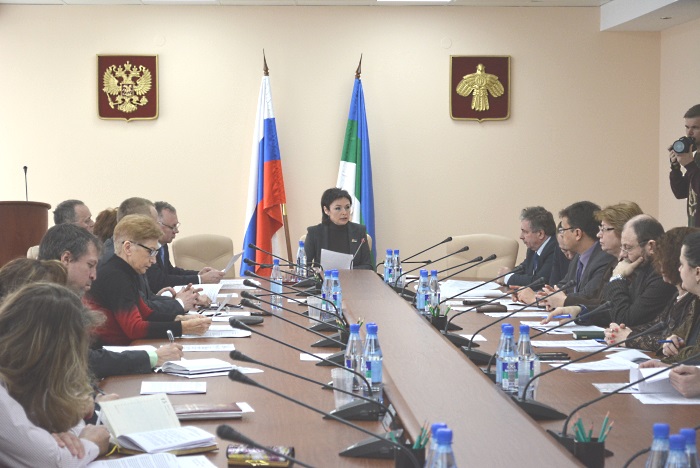
Deputies of the State Council of the Komi Republic, representatives of the executive power of the republic, scientists spoke for maintaining of the Moscow time in Komi, which coincides with the natural daily rhythm of the republic citizens. This is the conclusion of the round table, devoted to the discussions on the federal law draft concerning entering amendments to the system of time keeping.
Federal legislator intends to move the time across the country to the “winter time” by turning the clock back for one hour. The number of time zones will be increased, and it is proposed to introduce “Moscow time plus one hour” in Komi - the republic would be in the third time zone together with the Perm oblast, Bashkortostan and Orenburg oblast. The regions will also lose the right to influence their reference to a particular time zone when applying to the Russian government.
As it was explained by Alexandra Bushueva, roundtable moderator, Deputy Chairman of the State Council of the Komi Republic for Natural Resources, Environment and Ecology, the republic has been living for several decades according to the Moscow time - andits inhabitants are completely satisfied with this mode. Currently the regional legislative bodies are preparing remarks and suggestions to the federal law draft, so it is necessary to develop a single point of view - optimal for the people living in Komi.
The speakers almost unanimously expressed themselves in favor of maintaining the current time zone for the republic and preservation by the subjects of the Federation of the opportunity to determine their own time. So, Andrei Chernousov, First Deputy Minister of Economic Development of the Komi Republic, reported that after the transition to the permanent summer time in 2011 in the republic there were no changes in the energy consumption system, transport working time, communications, industrial enterprises, and health figures ofthe population remained normal. Positive effect revealed in the livestock breeding: earlier under the annual transitions from the winter time to the summer time and back yields of cattle fell by 10 percent - now this problem no longer exists. “The monitoring, which was carried out, did not give a clear understanding of the appropriateness of the clock transition” - said the official.
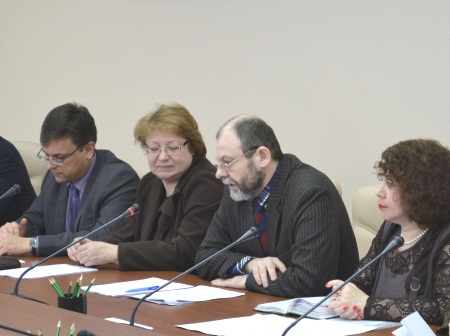
According to him, life by the Moscow time is convenient for Komi, because according to it rail road, auto- and air transport operate, mostly directed to the west and south-west, where time is measured according to Moscow. In addition, the lawdraft implies to leave the Nenets Autonomous Okrug, Kirov and Samara Oblast, the Udmurt Republic in the Moscow time zone, although they are located on the same longitude as the Komi Republic. “The timing different from the Moscow one will affect social tension, transportation, professional and business contacts - said A. Chernousov. The Komi Republic is unique in that that the Moscow time coincides with its basic natural time.”
He said that on the web-site of the Institute of Social economic and energy problems of the North of Komi of the Scientific Center of Uralic Department of RAS (Russian Academy of Science) there was organized a survey in relation to the time transition in the republic - 84 percent of respondents voted against changing the current system.
Iaroslav Bordiug, Minister of Health of the republic, was more cautious, expressing himself in a way that the evidence of the people’s health state worsening in connection with the transition to the winter and summer time is not sufficient. “We examined it – everything is dragged in – as the Minister figuratively expressed. – We conducted our own research to find out the dynamics of patient addressing to the outpatient clinics, ambulance, trauma centers – there are no significant changes, no worsening dynamics.” At the same time, the official still acknowledged that the clock transition affects the human body in a stressful way, and difference from the Moscow time zone will affect the well-being seconded to the Russian capital.
Dmitry Belyaev, First Deputy Minister of Education of Komi, agreed with the previous speaker, who said that the negative effect of the clock transfer for students is not observed.” Technically, we are ready for any change, but how it will affect each of us - I think scientists will show it in terms of biology and physiology,” - he concluded.
Eugeniy Boiko, Head of Department forEnvironmental and Medical Physiology of Institute of Physiology of Komi Scientific Center of Uralic Department of RAS noted that there is noscientific component in the submitted for discussion federal law draft; the material based on the Novosibirsk data does not stand the criticism, and is not suitable for analysis of the situation in other regions. However, he said, the time change in the previous periods of history, including the Soviet era, was not based on any worked out conclusions and was decided behind the scenes.
The scientist said, unexpectedly for the gathered, that he sees nothing wrong with the annual clock transfer for an hour and back: “An hour shift for physiology is nothing, two or three hours - that's another story”. Then he said he believes the winter time abandoned three years ago was good.
Larisa Popova, Deputy Director for Science of Institute of Social Economic and Energy Problems of the North of Komi of the Komi Scientific Center of Uralic Department of RAS, also spoke in favor of the republic to remain within the Moscow time - but the winter one. She said that Udmurtia and Samara Oblast, previously living in the zone “Moscow plus one hour” moved to the Moscow time two years ago, and according to the new law should remain in it - then why it is talked about moving the Komi Republic?
The meeting participants also drew attention to the drawbacks of the law draft from the standpoint of legal formulations, offered to consider the opinion of physiologists when writing the final version of the document.
As a result, it was decided to recommend to the State Council of the Komi Republic and Head of the republic to apply to the State Duma of the Russian Federation and the Russian government with a proposal to retain the right of the regions to participate in their attributing to the time zone and, in particular, to include Komi in the second (Moscow) zone.