
 At the beginning of 2014 there was launched an international project to create an open electronic annotated corpus for further research of the Izhma dialect of the Komi language. The project received financing from the KONE fund (Finland) and is designed for three years. This was reported to the Media Center FINUGOR by the project participants in Syktyvkar: Marina Fedina, Head of the Center of Innovative Language Technology of Komi Republican Academy of Public Administration and Management, Michael Rissler, scholar from the University of Freiburg, the Sami languages researcher, Rogier Blokland, scholar from the University of Munich and Niko Partanen, postgraduate from the University of Helsinki, researcher of the Komi language.
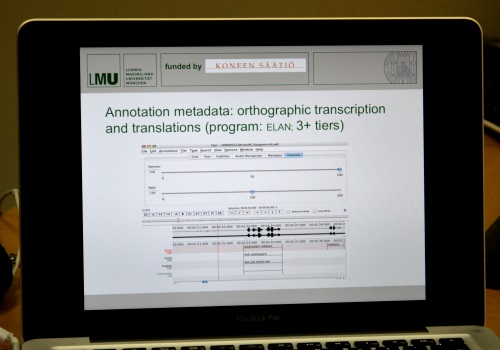
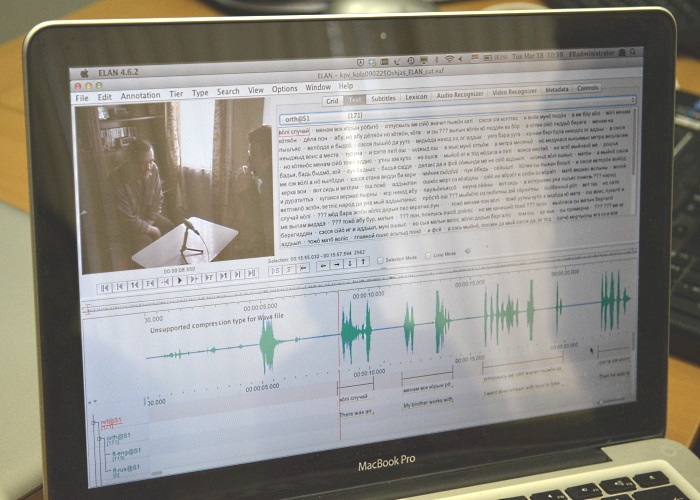
According to the western visitors to the Komi capital, Finno-Ugric languages except Hungarian, Finnish and Estonian, are in danger of extinction, to various degrees, especially difficult the situation is with indigenous small-numbered languages and individual dialects. In recent years, there are being actively implemented projects on documenting the languages, which enable documenting live spoken language through audio and video recordings, and partly to digitize existing printed materials. As explained M. Rissler, this project uses editing program ELAN, which enables connecting multimedia files with fragments of text record of the native speaker speeches and thus gives linguists and everyone interested an opportunity to work with them as a base of formalized language data. To the records of the Izhma dialect there will be added annotations in the literary Komi language, in Russian, English and German. “Previously it used to be that way: if the data archive with annotations in Russian was created in Russia, it was inaccessible to the western scholars, if similar work was done in the western countries and annotations were written in English or German - Russian researchers did not work with them. Our project will provide the opportunity to work with recordings in Russia and in other countries,” - said R. Blokland.
The compiled corpus of records will be included in the language file and will be open to everyone who wishes to study it and work with the records.” Documenting the language is only the first stage of working with it, after that linguists make the description of the language - its grammar and other aspects. The third stage is when scholars write special articles, based on the available material. But we are working only on the first level – at the fixing of a living language. In addition, if previously linguists preferred to choose native speakers with a “pure” language and recorded from them myths, epics, stories about the past, for us it is more important to show how the language is used today: it is the process of buying in the store, and the conversation in the queue, and repair of some household items – all these situations in the native Izhma dialect of the Komi language. Moreover, we are interested in those who are not very fluent in their native language: we will fix, at what level and in what form they use it,” - said M. Rissler.
Previously, researchers themselves got acquainted with materials on the Izhma dialect in Helsinki, and M. Rissler communicated with the Komi Izhma (Izvatas) in the Murmansk Oblast of the Russian Federation, when he ran a similar project for the Kola Sami. In the course of the new project there will be studied the existence of the Izhma dialect in the Izhma Region of the Komi Republic, the Izvatas of Syktyvkar, there will also be carried out fieldwork among the Izhma people in other regions of the Russian Federation - the Murmansk Oblast, Nenets, Yamalo-Nenets and Khanty-Mansi Autonomous Okrug. “Who knows, maybe over time it will be possible to do documenting of other dialects of the Komi language, then we proceed to the Komi-Perm and Komi-Yazva languages, the Udmurt, the Mari language and so forth,” - R. Blokland commented on the prospects.
According M. Rissler, it is important to study how the Izhma dialect of the Komi language interacted with languages of the indigenous peoples – the Sami, the Nenets, the Mansi and the Khanty languages and, of course, with the Russian language. On the other hand, it may be possible to document the influence of the Izhma dialect on the languages neighboring the Izvatas.