
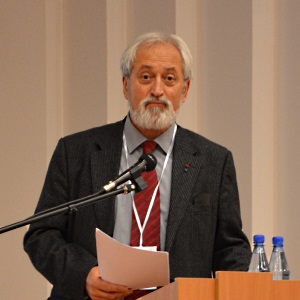
 FINUGOR information centre presents an exclusive interview with linguist, professor, director of «Collegium Fenno-Ugricum» Institute Janos Pusztai. In this interview famous researcher of Finno-Ugric languages states his point of view on Finno-Ugric and Samoyedic languages’ today’s condition and also their future. According to J. Pusztai, his unexpectedly hard assessment must instigate his colleagues, teachers, social activists and officials to make necessary efforts on preserving Finno-Ugric languages.
Honorable professor! Two conferences discussing questions of preserving Finno-Ugric languages, their current condition and their future were held recently in Syktyvkar. How do you evaluate the situation in this sphere?
There are about 6-7 thousand languages in the world today. Unfortunately, the process of globalization leads to the fact that by the end of this century this number will decrease by at least 10 times. There will be only 5-6 major languages such as, for example, English, Spanish, Chinese, Arabian… There are comparatively large languages which are not even considered as official languages but there is no threat to them: there are some languages in India, dozens and even thousands of millions of people speak them. The largest language among Finno-Ugric languages – Hungarian – is only on 45th place with its 13 million speakers. Should I mention languages of Finno-Ugric peoples living in Russia! This is harsh reality; we should evaluate it and make right decisions. And the languages of small-numbered peoples are going to become extinct; the sphere of existence of even comparatively large by today’s standards languages will become narrower.
Speaking about languages of Uralic language family spread in Russia, I’m, unfortunately, sure that most of them will disappear in the next few decades. Only large ones will survive – Komi, Udmurt, Mari language, Erzya language, Moksha language and maybe Karelian language. The rest of the languages will not be possible to save, that’s the global tendency.
Speaking about surviving of so-called “large” Finno-Ugric languages of Russia – what actions should be taken for their preserving and development?
— The first step is already taken: on the European Union grant terminological school dictionaries on five languages (Komi, Mari, Moksha, Udmurt and Erzya) on ten school disciplines including mathematics, physics, chemistry, etc. were prepared and published. That means it is possible to teach in these languages as it was before, up to 1960s! Necessary terminological base already exists, we can’t now refer to these languages’ lack of development. Of course, creating terminological dictionaries isn’t all, now we need textbooks on all those disciplines written in Finno-Ugric languages. And that’s only school level, then dictionaries, textbooks, articles and monographs in these languages. When aforementioned Finno-Ugric languages could be easily used in teaching, science, mass-media, social life, it won’t be necessary to switch on the majority language – in this case it’s Russian language.
The most important part is teaching in mother tongues: not just teaching them as school disciplines, but teaching all the school lessons in these languages. Of course, it depends on the authorities. I suppose that Russian authorities are talking about supporting all the languages in the country in last few years… But I won’t comment on Russian politics, it’s up the country anyway.
Activists of ethnic movements in Russia are interested in experience of Finno-Ugric countries of Europe and experience of small-numbered European languages revival. In the last few years a lot was written about the revival of such languages as Manx, Cornish, Scottish Gaelic and some others. How do you think, is it possible to use this experience for Russian Finno-Ugric peoples?
— I think the best example is Welsh language in Wales. Manx and Cornish languages are still few in number, and situation with them can’t serve as an example yet. Scottish Gaelic language in Ireland is making progress, about one third of country’s population speaks it (according to other ratings, from 50 to 90 thousand people from Ireland’s 4,5 million population. – ed.). But this is an example of the country which got independent almost hundred years ago. And Wales was and still remains a part of the United Kingdom, that’s why its experience is more valuable from the practical point of view for small-numbered peoples of Russia.
Several decades ago Welsh language was in a really difficult situation. The number of people speaking it was reducing under the pressure of English language. Then the ethnic movement for the language revival started its work, and the main moving power was young people. It was not possible to give official status to Welsh language, and Finno-Ugric languages in republics of Russia have it. it was decided to make Welsh language fashionable to young people! All possible forms of using the language were created, the language was making popularized, it was shown that this language can be used along with English language or even instead of it. Teaching of Welsh in schools of Wales became wider, but it’s not obligatory, the decision is up to school.
It’s an interesting situation in Wales now: Welsh language is used basically by young people. And if so, it’s almost sure that the language will live further.
And is everything well with “the largest” Finno-Ugric languages – Hungarian, Finnish, Estonian, which are used by millions of people and which have governmental supports in their states?
— Globalization is a process reaching everywhere and having influence on everybody – at least it’s true for Europe. The dominant language which is now English puts pressure on all other languages. For example, do you now that in Sweden English language is often used in conversations on political and scientific subjects because it’s considered that there are not enough language tools in Swedish language to convey the idea? And we are speaking about a country with population of 8 million people! And in Hungary anglicizes penetrate into Hungarian language, they are mostly used in conversations of young people. And speaking about science… In natural, technical sciences and in medicine only works written in English are considered to be scientific. This is demanded by our Academy of Sciences, but it’s also a demand of international scientific community: your article must be written in English to make it possible for others to read it, to make it available for indexing and referring for other scientists. It must be in English, not in Hungarian and not even in German, even though not long ago German was the language of science, it was particularly actual for Finno-Ugric studies. The main situation is in Finland and Estonia. All the science is now developing in English, not in mother tongue. It will affect little by little on our languages too because if we won’t have developed professional terminology for modern phenomena – our languages will become less prestigious, they will fall behind.
But that’s not the end of the troubles. As you know, after the World War I Hungarians live not only in Hungary but also in some neighboring states. Within last few decades, Hungarian language of foreign Hungarians was involuntarily affected by local official languages and it’s again especially true for science and also for social and political sphere. And now there are some differences between Hungarian language of Hungarians in Slovakia, Romania, Ukraine, Serbia and Hungary itself. If right after the Trianon (1920s the Treaty of Trianon separated the Hungarian part of Austria-Hungary, so Hungarians found themselves in different countries – ed.) Hungarian officials could have thought the problem through, glimpse into the future – they would support standardized Hungarian language not only inside the country, but outside it, too. But nobody was thinking about at that time. And today we need to create parallel dictionaries containing lexical differences: Slovak-Hungarian – Hungarian-Hungarian-Slovak, Romanian-Hungarian - Hungarian-Hungarian-Romanian and so on. It would be possible to look into such dictionary and find necessary correspondence when finding an unknown word in a text written in Hungarian language which seems native to you. And that’s only we can do now.
But we can’t give up, of course. We should fight for our languages, we should develop them. Government support means a lot for preserving mother tongues, also as active work of ethnic intellectuals, especially professional philologists; involving young people into using mother tongue.
Thank you for your answers!