
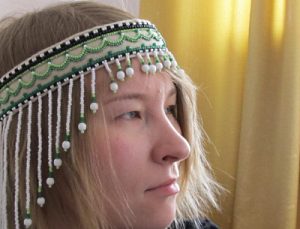
Media centre FINUGOR presents a shortened version of an exclusive interview with small languages revitalization expert, Inari Sami language saving projects in Sami region of Finland participant Annika Pasanen. The interview is dedicated to the questions of saving minority languages (the full variant is available in Russian). The expert exposes details of the project on saving Inari Sami language and declares about the possibility of using this experience for any other minority language.
Annika, linguosocial technology of small Finno-Ugric languages’ preserving by educating children in “language nests” – kindergartens where children are speaking their native language all day long – was suggested to Russian Finno-Ugors by Tarja Halonen, who was the president of Suomi at that time, on V World congress in Khanty-Mansiysk in 2008. Several years have passed and “language nests” have opened in different regions of Russia: from Karelia to Taymyr. But of course there are people who are showing their skepticism to this idea: in particular, famous researcher of Finno-Ugric languages Janos Pusztai states that it is only possible to save languages with a number of native speakers which is more than 100 000 people. So, does it mean that the smallest Finno-Ugric and Samoedic languages do not have any chance to survive?
In my opinion, the idea of pointing some numbers as an indicator of “survival” has no sense. There can be any number of native speakers – even very small. What’s important for preserving the language – it’s the will of the people, of its ordinary representatives – to save their native language and share it with next generations. Of course, government’s, society’s or charity organizations’ help is important, they can help financially.
Janos Pusztai’s statement seems even immoral to me somehow. He is a famous scientist, one of the leading figures in Finno-Ugric world, his word means a lot for colleagues – linguists, professors and general public. Moreover, in Hungary he influences the EU Grant for language projects. And he “buries” minority languages in advance just like that!.. It’s really dangerous to make statement like that, because language representatives themselves, social activists, authorities may do nothing now- they have already been told that “saving minority languages is impossible”!
On the real thing, it is possible to save perhaps any language. An experience of saving Inari Sami language in Finland proved it right.
Several years ago we were discussing the chance of saving the small Votic language using the method of “language nests”. You’ve said that it is hardly possible because Votes do not have middle-aged native speakers who are able to work as kindergarteners – those few Votes who speak their language are over 60 years old…
Yes, but now I can say, basing on the experience with Inari Sami language, that Votic language has its chance to be saved, too. It all depends from Votic people’s will and involving necessary resources like linguists-specialists and money. Government’s desire to save small languages is important, too.
The point is that at first, in Inari the “language nest” was organized in kindergarten because it was decided to teach Inari Sami language to children whose parents do not already know the language and can’t give that knowledge to their children. Of course, it wasn’t easy at all: after chatting in Inari Sami in kindergarten, the child was coming back to Finnish-speaking surrounding. And after kindergarten the school begins – how should we deal with that?
But the project was growing. We started teaching in Inari Sami language – it’s actually the same “language nest”, but now in school, not in kindergarten. And parents got interested in their native language! Middle-aged Saami people were coming to us and asking us to teach them their ancestor’s language. We’ve organized Inari Sami language courses for grown-ups within the project: youngsters were coming there too, together with the people over 40. Students’ average age was about 35 years old. Those courses for grown-ups are functioning for about 5 years by now.
But who has taught children and grown-ups to speak Inari Sami language? This is the key question for organization of “language nests” – and Votic language is an example of it. Where do you get teachers from?
That is a good question! We didn’t have the situation when we had everything at once: people who know the language, people who can and want to teach the language, exercise books on the language… Everything was coming little by little. For the very first language group in Inari there were two teachers: one of them, a woman, knew Inari Sami language since her childhood, but passively. That means she could clearly understand it when she heard it, but didn’t use it actively in her speech. The second teacher – a man – spoke Sami language perfectly. And those two people have started working with children. Now there are already 9 teachers of Inari-Sami language for “language nests”, and most of them have learned the language exactly while taking the course.
Those courses are pretty thorough. It’s not possible to learn the language by learning it 1-2 hours a week. It was managed that the courses started since the middle of August and continued up to the next years end of May - this is the whole academic year, as it is said in Russia. And classes were held during the whole working day. For 9? 5 months of such intense studies the learners became able to speak the language fluently, but of course not all of them have made it through the whole course. Moreover, older generation Sami were invited as so-called “masters of the language”: every learner had his own partner – an elderly Sami, who spoke Sami with his younger partner all day long, explained whatever his partner did not understand, and stimulated the communication. Learners were tried to be involved into Sami’s traditional activities like fishing, going to deer herd or doing some home work. So it works both ways – it’s getting to know Sami’s traditional culture and also learning lexis of different spheres of life. Sure there were cases when the learner and his “language master” didn’t go anywhere and just stayed at home getting carried away with the conversation with each other… But this is not a problem – the important thing is that they were having a conversation in Sami!
Annika, how many children and how many people of middle age have taken classes of Inari-Sami language and have been in “language nests”?
I assume, for all years of project’s work nearly 70 children have been in “language nests” in kindergartens and about 70-80 people took language classes.
This is not a small number for Inari-Sami – people with population of about 300 people!
I will just clarify that this number doesn’t just include Inari-Sami themselves, but also Finns who have learned Inari-Sami for different reasons. Let’s take my family: me, Finn, learned Inari-Sami, both of my children – son and daughter – were in “language nest” and now are successfully continuing their education in school in Inari-Sami language. And there are many Finns nowadays with this experience nowadays. Inari-Sami language became popular in Inari commune, people are longing to learn it speak in it. I am constantly living in Inari, here is my house and I don’t want to be a person on Sami land who comes there and assimilates small people, makes them Finns… I want Inari-Sami language to be saved and to develop. The more Finns learn it the better. And it became more prestigious among Sami themselves, because as I have already said the middle generation of Sami people is now willing to get their language back.
Let’s go back to Votic language as an example of small Finn-Ugric language. Turns out, it’s possible to save it?
Yes, but only if Votic people would want to learn the language of their grandfathers and grandmothers, if we can find the money for the project, involve Votic language knowing philologists, create handouts… The development of a language itself is also important – how modern its vocabulary is, if there are enough corpuses of texts, if the language is fixed well enough by linguists. Votic language has quite serious problems with modern vocabulary.
Annika, you have spoken about Inari-Sami language in details. And do we have more examples of preserving minority languages in Europe, examples which will be useful to Russian finn-ugrics?
I guess, Gaelic language in Scotland and Irish (Celtic) languages in Ireland could serve as examples: it’s all pretty good with them now because there were taken strong measures for preserving those languages. For example, in Ireland their native language is taught in schools, all the signs are written in two languages and the inscription in Irish goes first and the inscription in English comes only after it.
But in spite of all efforts the number of Irish-speaking people in Ireland is now not higher than 70-90 000 people from country’s 4, 500 000 population. What is the matter? After all, there is strong state support.
To be honest, I can’t explain the case with Irish language: it is preserved, it has been developing and getting new functions, but in fact most of the Irish didn’t get fluent in the language although they’ve had been learning it in a school. Maybe English language still dominates in Ireland being number one language of the world.
In general, is the problem of minority languages disappearing actual, as Janos Pusztai predicts? There are examples of European countries which had strict language policies pointed against minority languages – like in France, where the principle “one state – one language” was realized ever since the French Revolution and Napoleon’s reign…
Yes, there are countries in the world where minority languages were under great pressure for a long time, the number of native speakers was decreasing. If we are worried about decreasing number of Finn-Ugric languages speakers in Russia, we must say that other countries had similar examples. But I’m not agree with categorical statement that small languages will disappear. No, they have a chance to survive. Linguists’ counting show that languages with 5-10 000 of speakers are found most often in the world and they do not disappear for centuries and thousands of years. Yes, they are experiencing pressure from the world languages, but I don’t believe that small languages will be gone forever. No, they have an ability to be preserved. There is a tendency to reducing the number of small languages, but we still can take efforts to their preserving and even revitalization. Small number of native speakers is a risk factor for its surviving, but it’s not the most important factor as Janos Puzstai claims. Only 300 people speak Inari-Sami, but this language has a chance to continue its existence in future.
There are specifics in saving small languages in Russia – school lessons are taught in Russian, that’s why a number of native speakers isn’t so important, because “big” small languages and the ones that are even smaller are in same conditions. And I am, of course, agree with professor Pusztai that lessons in schools must be also taught in native languages. And if it isn’t so, all the languages of the world may disappear and it doesn’t depend on number of native speakers.
But I will stress that once again – small peoples representatives should be active themselves for that. And government must help them, too.