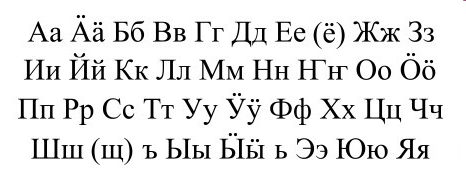
The possibility of using minor Finno-Ugric languages of Russia on the Internet, in the software, in the innovation systems, first of all, depends on willingness of the native speakers themselves to use these languages in the above-mentioned fields. However, some purely technical aspects are also of considerable importance: it is necessary that the Unicode Consortium confirmed all the letters of these languages’ alphabets, ISO 639 codes of a language or a dialect; there is also need of a defined locale, keyboard layout, and electronic dictionaries. Media centre FINUGOR was informed about it by our expert in digital facilities and software of the Finno-Ugric languages Andrey Chemyshev.
Unfortunately, many organizations, which make the most important decisions in this sphere, are situated in the USA. For example, the resolution concerning inclusion of the new codes into the ISO standard is made by the Joint Advisory Committee of the Library of Congress, Washington, USA, - he explained.
According to him, the most urgent problem at the present moment is that of usage of texts, written in the Finno-Ugric languages, in the new software. The fact is that Finno-Ugric alphabets usually have letters, missing in the conventional Roman and Cyrillic alphabets, and without being approved of as ISO standard, they will not function in the software. “Thus, object based programming languages, which are used for software construction, have considerable difficulties with recognizing letters, missing in the Roman and Cyrillic alphabet,” – described the state of things A. Chemyshev.
“At present, people still read usual printed newspapers and books, however, in the near future information will be provided by the digital media; books publishing will also depend on the corresponding programs, which are used by imposers and designers. Within 5-10 years the language, which is not adequately represented in the software, will be impossible to use, it will literally die,”- clarified the expert.
Today only “great” Russian Finno-Ugric languages have unique three-letter codes according to the international ISO 639 standard: they are Karelian (krl), Komi (kom) and Komi-Permyak (koi), Mari (chm, including Meadow Mari (mhr) and Mountain Mari (mrj)), Moksha (mdf), Udmurt (udm) and Erzya (myv).